How Astra Pentest Helps You Achieve Compliance?
Last updated: November 24, 2026
Most security frameworks ask you to find and fix vulnerabilities regularly. Astra's automated scans and manual pentests cover that vulnerability assessment and penetration testing (VAPT) part. The rest of each framework, such as policies, processes and the audit itself, happens outside Astra.
This article explains what Astra covers for common frameworks and what you still need to do yourself. To see how your own findings map to each framework, use the 📄 Compliance Mapping page.
Astra helps you find and fix the issues to resolve before an audit. It doesn't issue compliance certificates or guarantee that a product is compliance-ready.
PCI-DSS
PCI-DSS protects cardholder data, and applies to any business that stores, processes or transmits card data.
Astra helps with:
Regular scanning and pentesting to find vulnerable areas.
Checks for injection flaws, such as SQL, LDAP and CRLF injection.
Checks for cross-site scripting (XSS), broken authentication and session management.
Checks for insecure communication and man-in-the-middle risks.
Privilege escalation testing with authenticated attacks.
Outside Astra: install and maintain a firewall, protect stored cardholder data, encrypt card data in transit, track and monitor network access, and keep a security policy.
GDPR
GDPR is the European Union's data protection regulation. It applies to any organization, wherever it is, that processes personal data of people in the EU.
Astra helps with:
Regular pentesting and scanning to find weaknesses that could expose personal data.
Finding SQL injection before an attacker does.
Finding insecure data transfer, such as traffic over plain HTTP.
Finding source code leaks.
Outside Astra: have a legal basis for processing, explain it in your privacy policy, train your team on data protection, have a breach notification process, and name someone responsible for GDPR.
HIPAA
HIPAA is a US law that sets standards for the privacy and security of protected health information (PHI).
Astra helps with:
Regular scans and pentests to find gaps in how health data is protected.
Finding vulnerabilities that allow unauthorized access to sensitive data or could leak electronic PHI.
Rescans after fixes, to confirm the issues are resolved.
Outside Astra: name a HIPAA Privacy Officer, assess risks to PHI and put safeguards in place, write policies for using and disclosing PHI, and review your Business Associate Agreements.
SOC 2
SOC 2 is an AICPA auditing standard for the security, availability, processing integrity, confidentiality and privacy of a service provider's systems.
Astra helps with:
The Security, Confidentiality and Privacy trust services criteria.
Finding source code leaks, privilege escalation paths and server-side template injection.
Outside Astra: decide your audit scope and objectives, choose your trust services criteria, and run a gap assessment.
ISO 27001
ISO 27001 is the international standard for information security management systems (ISMS).
Astra helps with:
Regular pentests and scans of websites, APIs and networks.
Testing against widely used lists such as the OWASP Top 10 and SANS 25.
Supporting confidentiality, integrity and availability, the three pillars of an ISMS.
Outside Astra: write a top-level information security policy, define your risk assessment method, and carry out risk assessment and treatment.
Showing your progress
The Compliance Mapping page maps your vulnerabilities to SOC 2, PCI-DSS, ISO 27001, GDPR, HIPAA, DORA, NIST 2, MITRE and OWASP 2021. Read 📄 Overview: Compliance Page.
Where available, Download Compliance Report creates a report of the vulnerabilities mapped to these frameworks.
A Trust Center shows customers your security posture. Read 📄 How to Create and Configure Trust Center for your Targets.
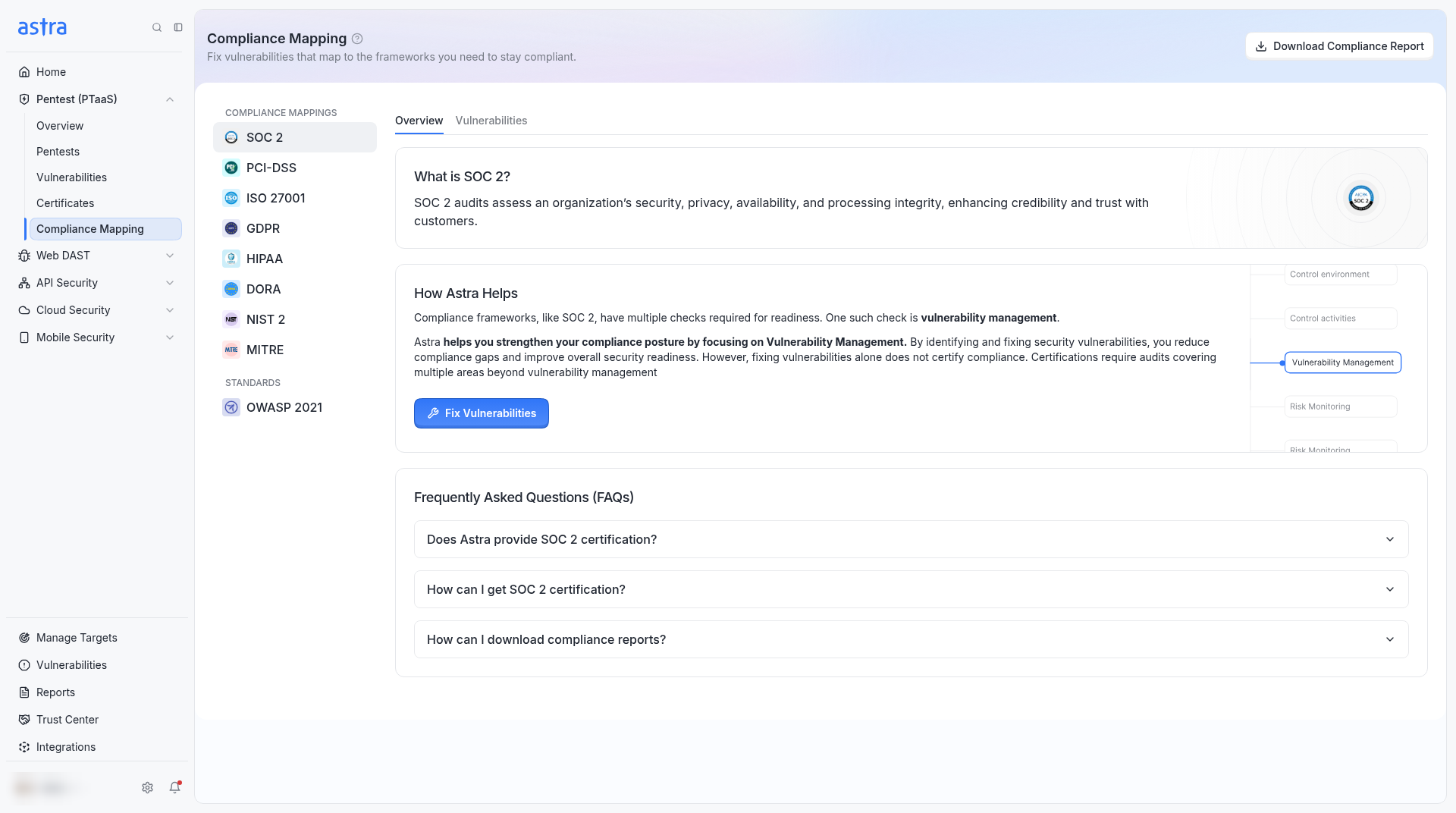
The Overview tab of the Compliance Mapping page for SOC 2. The frameworks are listed on the left.
If you have questions about using Astra for a specific framework, contact support from your Astra dashboard or reach out to your CSM.